
29 October 2026 | NARRATIA Project News
How can cultural heritage experiences move beyond sharing information to creating meaningful connections with the past?
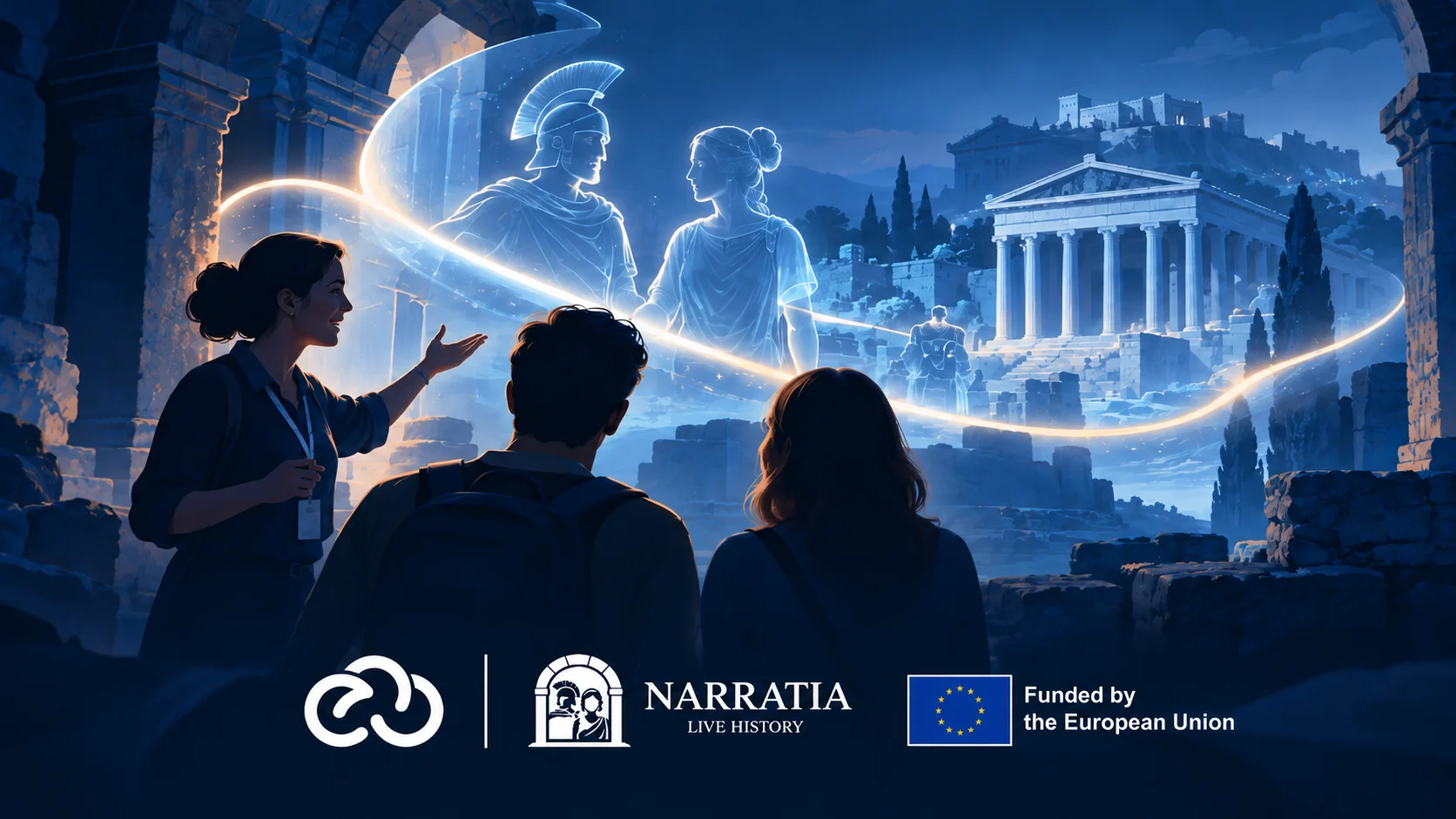
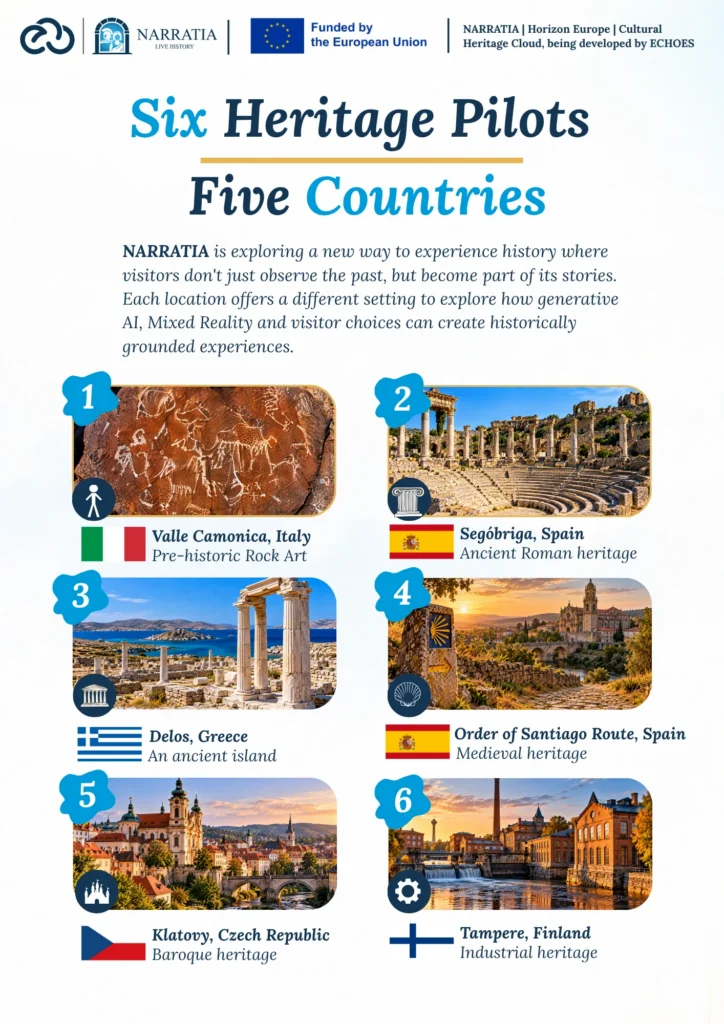
This question was at the heart of NARRATIA’s latest collaborative pilot design meeting in October 2026. As part of the project’s methodology development and preparation of six European cultural heritage pilots, partners reviewed initial experience concepts and advanced a shared approach to immersive, historically grounded storytelling.
The discussions marked an important step towards turning NARRATIA’s vision into practical design principles for visitor-centred cultural heritage experiences.
Putting Storytelling at the Centre of the Visitor Experience
A central conclusion was that NARRATIA is not simply about delivering historical information. It is about enabling visitors to become active participants and co-creators of meaningful stories.
Rather than experiencing only predefined narratives, visitors could influence how their stories unfold through their choices, questions and interactions.
The meeting reinforced five key principles for creating engaging heritage experiences:
- Meaningful storytelling: Building coherent narratives around compelling historical contexts, human experiences and moments of change.
- Visitor agency: Giving visitors opportunities to participate in shaping their own narrative journeys.
- Historical credibility: Grounding stories in reliable sources, curatorial expertise and authentic heritage contexts.
- Inclusive interpretation: Recognising diverse perspectives, accessibility and different visitor needs.
- Experience-driven design: Connecting storytelling, technology and the physical heritage environment into a coherent visitor experience.
The immediate outcome was an emerging shared design direction for NARRATIA’s pilot experiences, bringing together five storytelling principles that will inform the next stages of experience development and testing.
Combining Creative Storytelling with Heritage Integrity
The emerging approach also reflects international principles for responsible cultural heritage interpretation and the use of artificial intelligence in culture. The 2024 ICOMOS Charter on Sites with Intangible Cultural Heritage highlights the connections between heritage places, living traditions and communities, while UNESCO’s Recommendation on the Ethics of Artificial Intelligence (2021) and the 2025 independent expert report on AI and Culture emphasise human agency, cultural diversity and ethical responsibility.
These principles emphasise accessible understanding, reliable historical information, authentic context, inclusiveness, heritage preservation and continuous evaluation.
For NARRATIA, this means that creative storytelling should not come at the expense of historical accuracy or cultural integrity.
The project is developing a combination of generative AI, Mixed Reality and responsible narrative governance to support experiences that can adapt to individual visitors while remaining within historically credible and ethically appropriate boundaries.
The goal is not to let technology invent history, but to enable visitors to discover and engage with it in new, personally meaningful ways.
Towards More Engaging and Reusable Heritage Experiences
The discussions helped clarify common storytelling principles and practical design requirements that will guide the next stages of NARRATIA’s development.
These early outcomes support the project’s ambition to create a scalable generative narrative and Mixed Reality solution that can be adapted to different cultural heritage environments.
The emerging methodology could also contribute to future reusable tools and approaches within the European Collaborative Cloud for Cultural Heritage (ECCCH) ecosystem.
The next steps will focus on refining experience concepts with heritage experts and site representatives, followed by further technical development and testing.
Ultimately, NARRATIA aims to help cultural heritage organisations create experiences that encourage curiosity, participation, historical understanding and stronger connections with the past.
Because the most powerful heritage stories are not only those we hear — but those we become part of.
Sources and Further Reading
- NARRATIA Consortium (2026). Collaborative Pilot Experience Design and Methodology Development, 29 October 2026. Internal project documentation. [Exact document title to be confirmed.]
- ICOMOS (2024). International Charter and Guidance on Sites with Intangible Cultural Heritage.
https://icich.icomos.org/index.php/about-icich/ich-charter/ - UNESCO (2021). Recommendation on the Ethics of Artificial Intelligence.
https://www.unesco.org/en/legal-affairs/recommendation-ethics-artificial-intelligence - Independent Expert Group on AI and Culture, convened by UNESCO (2025). Report of the Independent Expert Group on Artificial Intelligence and Culture.
https://www.unesco.org/en/articles/new-expert-report-explores-how-ai-transforming-culture - ICOMOS (2022). International Cultural Heritage Tourism Charter: Reinforcing Cultural Heritage Protection and Community Resilience through Responsible Tourism Management.
https://www.icomosictc.org/p/2022-icomos-international-cultural.html - UNESCO World Heritage Centre (n.d.). Interpretation/communication of World Heritage properties. https://whc.unesco.org/en/faq/290